

Air Handling Unit Factory Tour Reveals Advanced Manufacturing Processes Behind Reliable HVAC Systems
2026-10-13
Walking through an air handling unit factory tour isn’t just about watching machines—it’s a front-row seat to the advanced manufacturing processes that turn steel, coils, and controls into the reliable HVAC systems buildings count on. We followed the line at shairko from raw sheet metal to final pressure test, and what stood out wasn’t the noise or the sparks. It was the obsessive attention to tolerances most people never think about. Here’s what that tour revealed, and why it changes how you should look at the air handler on your next project.
First Stop: The Raw Steel That Becomes an AHU Casing
Before an air handling unit takes shape, it begins as coils of sheet steel waiting in the yard. The casing that will eventually house fans, filters, and coils depends on the quality of this raw material. Most manufacturers start with galvanized steel, chosen for its balance of strength and corrosion resistance. In coastal or chemically aggressive environments, stainless steel often replaces it, adding years to the unit's life but also pushing up cost and fabrication difficulty.
The steel arrives with a thin zinc coating or a brushed finish, depending on the specification. It is then leveled, cut, and bent into panels that must fit together tightly enough to prevent air leakage. Small variations in thickness or surface defects become obvious once the panels are assembled, so incoming inspection checks gauge, coating weight, and flatness before any cutting begins. This early step rarely gets attention, but it quietly determines how well the finished AHU will hold up over decades.
Cutting, Bending, and the Tolerance Game
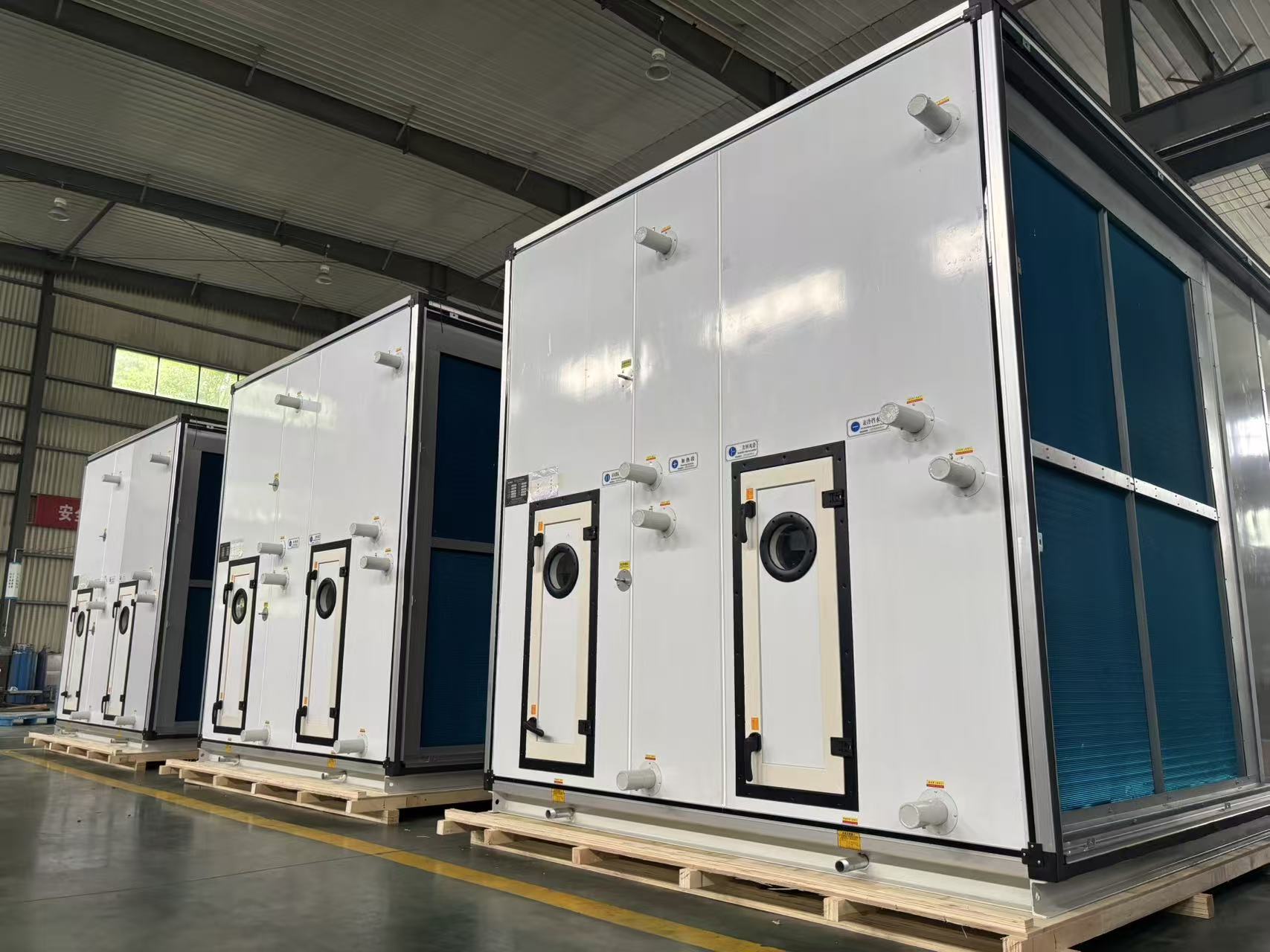
Sheet metal rarely sits still after a laser pierces the first hole. Internal stresses from rolling, slitting, or even the way a coil was stored can wake up the moment you cut a profile. A long slot might gape open by half a millimeter, or a narrow web between two cutouts can bow outward like a cheap bookshelf. Operators learn to read this movement the way a chef reads a pan—anticipating where the material will fight back before the torch ever touches the surface.
Bending adds a second layer of guesswork. Air bending with a press brake relies on punch penetration depth, but springback, material grain direction, and even tooling wear can shift the angle by a degree or two. Then comes the real headache: dimensions that were fine on the flat pattern suddenly shrink or grow once flanges fold up. The classic mistake is treating the bend deduction as a fixed number. It isn't. It drifts with thickness tolerance, die opening, and whether the operator uses the same bend sequence as the programmer imagined.
That's where the tolerance game turns personal. You can draw ±0.1 mm on the print, but the shop floor deals in ±0.3 mm because physics has a vote. Smart designers stop chasing perfect numbers and start asking where a feature can drift without killing the assembly. A tab that locates a bracket can hold tight; a cosmetic edge can float. The game isn't about eliminating variation—it's about deciding which variation matters and which variation you'll let the metal win.
Coils and Fans: Where Airflow Gets Its Muscle
The real work of moving air through a building happens in the coil-and-fan pairing, not in the ductwork alone. Coils are built from rows of copper tubing and aluminum fins, and they transfer heat by giving air a narrow, turbulent path to squeeze through. That geometry matters more than it looks: if the fin spacing is too tight, condensation builds up and blocks airflow; too wide, and the heat exchange drops off. The fan then decides how much of that treated air actually reaches the room. A forward-curved blower may be quieter but struggles against static pressure, while a backward-inclined or airfoil fan holds its volume better as filters load up. Matching these two components is less about raw horsepower and more about understanding the pressure drop across the coil at the airflow you actually need, not the airflow listed on a spec sheet.
Oversizing a fan to compensate for a restrictive coil is a common shortcut that backfires. You end up with more motor heat, higher duct velocities, and noise that travels through the building. Instead, look at the coil face velocity. If air rushes through the coil too quickly, moisture gets pulled off the fins and lands downstream, which leads to water where it doesn't belong and a coil that never quite dries out. Slowing the air down lets the coil wring out humidity and lets the fan operate closer to its best efficiency point. The muscle of the system isn't the fan by itself or the coil by itself; it's the way their curves intersect under real operating conditions.
Maintenance also tilts the balance. A coil that looks clean from the outside can still be plugged deep between the fins, and that hidden layer quietly raises the pressure the fan has to fight. The fix is often simple: measure the pressure drop across the coil instead of guessing by appearance. When the numbers climb, washing the coil or replacing the filter bank can bring airflow back without touching the fan speed. That kind of attention keeps the whole assembly from working against itself.
Why Skilled Hands Still Matter on the Assembly Line
Robotic arms can repeat a weld to within a fraction of a millimeter, but they still get confused by a batch of slightly warped brackets or a wiring harness that refuses to lie flat. Skilled assemblers make hundreds of micro-adjustments without thinking—tilting a part two degrees, easing pressure on a clip, choosing a different angle for a screw that’s chewing into plastic. That kind of tacit, fingertip-level problem solving doesn’t come from a spec sheet, and it’s exactly where the line keeps moving instead of stalling for a programmer.
Plenty of assembly work still depends on human senses that sensors can’t fully replicate. A thumb can detect a bearing that’s slightly rough before it goes into a gearbox. An ear can hear a connector snap into place rather than just looking seated. These judgments happen in seconds, often while both hands are busy, and they prevent defects that would only surface later in testing or, worse, in the field.
Keeping skilled hands around isn’t about resisting automation. It’s about recognizing that mixed-model lines, short production runs, and constant design tweaks favor people who can switch from one task to another without a lengthy reteaching process. Experienced assemblers also carry the unofficial history of the line—knowing that this batch of castings tends to run a little tight, or that station four’s fixture has always needed a shim. When a machine reaches the edge of its programming, that’s usually where a pair of practiced hands keeps the day on schedule.
Simulating Years of Duty in the Factory Test Bay
Inside the test bay, engineers condense a decade of wear into a matter of weeks. The floor trembles with the rhythm of pneumatic actuators cycling door hinges, drawer slides, and control arm bushings through thousands of repetitions an hour. Thermal chambers swing from sub-zero cold to desert heat while humidity generators push corrosion to the surface, exposing weak points that would only surface after years of real-world duty. Every rattle, every micro-fracture is logged, charted, and fed back into the design loop long before the first unit reaches a customer.
The challenge isn't just running components until they fail; it's replicating the messy, uneven stress of actual use. A test profile might mix a burst of high-speed actuation with long idle periods, or alternate between dust-laden air and salt spray to mimic coastal and desert deployments. Data from the field feeds back into these scripts, so what happens in the bay reflects not a generic duty cycle but the specific abuse patterns recorded from machines already in service. The result is a simulation that learns from reality and then pushes beyond it.
Custom Orders Without the Custom Wait
For years, custom furniture meant one thing: you pick a fabric, you get a lead time measured in months, and you rearrange your life around a delivery window that never seems to hold. We got tired of that story, so we rebuilt our workshop around a simple idea: small-batch production with on-demand material stocking. Instead of cutting every frame from scratch after you order, we keep a library of pre-cut, kiln-dried hardwood components ready to assemble in dozens of standard configurations. Your choice of finish, leg style, and upholstery doesn't trigger a new production run — it just pulls from what's already on the shelf, waiting to become your piece.
That shift changes how we talk to customers. When you send a request for a sofa with a deeper seat or a table at an unusual height, our team checks real-time material availability before quoting you a date. If the modification fits within our modular system, the wait is often under three weeks — sometimes as little as ten days. For more involved changes, like an entirely new frame shape, we can still move quickly because our prototyping process uses CNC templates that were refined on dozens of previous orders. No more “custom” meaning a blank slate and a blank calendar; it means your details, our proven methods, and a ship date you can actually plan around.
What you lose with this approach is the myth of infinite possibility. We won't build you a chair inspired by a sketch on a napkin and deliver it next week. What you gain is far more useful: a custom piece that arrives while the room it's meant for is still fresh in your mind. The fabric you chose hasn't been discontinued. The dimensions fit the space as you measured it. And the wait — if you can even call it that — feels less like a custom-order penalty and more like the time it takes to do the job right. That's the trade we'd make any day.
FAQ
Honestly, the precision of the coil fin stamping line surprised me the most. The fins are punched at speeds that leave almost no room for burrs, and the automated stacking ensures every coil has identical spacing—something you just don't get with manual assembly.
They use a combination of CNC folding and robotic seam welding. After each panel is formed, it goes through a pressure test where compressed air is applied and leak rates are measured. If a panel doesn't meet the threshold, it's rejected and reworked before it ever reaches assembly.
A big one. For example, the fan balancing is done on a dynamic balancing machine that detects even tiny imbalances and corrects them automatically. That directly reduces vibration and bearing wear, so the units run quieter and last longer in the field.
Every completed unit goes through a full functional test bench. Technicians simulate various operating conditions—different static pressures, temperature loads, and humidity levels—while sensors monitor airflow, power draw, and noise. Only units that hit all the target specs get a test report and a unique serial number for traceability.
Automation has removed a lot of variability. The insulation cutting is now done by a CNC knife that follows a digital template, so the insulation fits perfectly without gaps. Previously, workers would hand-cut it with a utility knife, which led to uneven edges and potential thermal bridging.
The galvanized steel panels are first degreased and then powder-coated with an epoxy-polyester blend. Internally, the coil fins get a hydrophilic coating to improve condensate drainage and resist mold growth. For coastal installations, they offer an optional electrocoated coil that withstands salt spray far better than standard fins.
Yes, the use of laser cutting for the fan scrolls. Instead of traditional stamping, they cut the scroll profiles with a fiber laser, which gives a clean edge and allows rapid design changes. This means they can produce custom scroll geometries for specific airflow requirements without needing new tooling.
Each raw material coil and sheet receives a QR code when it enters the plant. That code is scanned at each workstation, so the final unit's serial number can be traced back to the exact coil batch, coating lot, and even the operator responsible for that process step. It makes warranty claims and field failure analysis much faster.
Conclusion
Walking through the plant, the first thing that stands out is how much precision goes into something as seemingly simple as an air handler cabinet. The tour starts at raw steel coils, which are unrolled, leveled, and cut on high-speed laser machinery. What impressed me most was the tolerance discussion: the cutting and bending stations aim for fractions of a millimeter, because any misalignment in the casing later compromises thermal performance and air tightness. Seeing the coil and fan assembly areas, you quickly realize airflow is not just about big motors. Workers fit copper tubing and aluminum fins with careful spacing, then balance fan wheels to reduce vibration and noise. The mix of automation and manual skill is striking; some tasks still require a human touch to seat gaskets or align panels in ways robots cannot quite replicate.
Further down the line, every finished unit goes into a test bay where it is run through simulated years of duty. Temperature cycling, pressure checks, and airflow measurements happen before shipping, so failures show up in the factory rather than on a rooftop. The custom order area was equally revealing. Instead of long delays, the factory uses pre-staged modules and flexible assembly stations to handle non-standard sizes or special coil coatings quickly. Overall, the tour makes a strong case that reliability in HVAC equipment is not accidental. It comes from tight tolerances at the start, hands-on assembly in the middle, and rigorous testing at the end. That combination quietly separates a dependable air handler from one that merely looks good on a spec sheet.
Contact Us
Contact Person: Crystal
Email: [email protected]
Tel/WhatsApp: 8613524235353
Website: https://www.airkohvac.com