

Bespoke Warehouse Ceiling Fans: Tailored Designs for Ultimate Industrial Comfort
2026-07-12
When standard warehouse fans fall short of your facility's unique demands, tailored solutions can redefine industrial airflow. Explore how bespoke ceiling fan designs from VINDUSFAN combine precision engineering with customized comfort, transforming even the most challenging spaces into productive, energy-efficient environments.
Engineering Airflow Around Your Inventory Layout
How you arrange shelves and pallets directly shapes the way air moves through a facility. Without deliberate design, dense storage blocks airflow, creating dead zones where temperature and humidity stray from safe ranges. The goal isn't just to leave gaps—it's to treat those gaps as invisible ducts, guiding cool, dry air toward heat-sensitive goods and pushing exhaust toward return vents. By slightly angling rack rows or staggering high-density zones, you disrupt stagnant pockets without sacrificing cubic footage. Small shifts in layout often outperform brute-force HVAC upgrades, simply because air follows the path of least resistance—and you get to decide where that path leads.
Product characteristics should inform your airflow strategy from day one. Perishables and electronics demand tighter climate bands than raw materials, so placing them near central supply vents and away from dock doors prevents daily fluctuations. Meanwhile, bulky, heat-tolerant items can serve as natural thermal buffers along perimeter walls that face afternoon sun. The beauty of airflow engineering is that it turns existing inventory into a passive control layer. For instance, tall, solid stacks on the windy side of a warehouse can deflect drafts before they hit sensitive zones, while open mesh shelving near refrigeration units lets chilled air flow where it's actually needed, not just pool around the diffuser.
Adapting airflow to operational rhythms keeps conditions stable when layouts shift. Seasonal peaks bring extra pallets that choke airflow overnight, so training teams to realign product with seasonal wind patterns or solar gain becomes a no-cost habit. Simple visual cues—floor markings that show the “breathing zone” for each aisle—make it easy for forklift drivers to maintain clearances. Over time, this approach reveals patterns you can permanently build into the next redesign: which cross-aisles speed up air exchange, which loading patterns trap heat, and where a well-placed fan actually trims energy bills. The result is a layout that doesn't just store inventory; it actively manages the climate as part of daily operation.
Blade Profiles That Move More Air, Using Less Energy
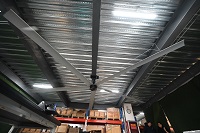
The secret behind a quiet, high-performance fan isn’t just a bigger motor—it’s the shape of the blades. When you look closely at our latest designs, you’ll see that each blade doesn’t have a uniform curve. Instead, the angle of attack gently shifts from the hub to the tip. This subtle twist lets the fan grab more air at the center, where the speed is lower, and smoothly release it at the outer edge without creating turbulence. The result is a steady, powerful stream of air that fills the room without the choppy noise you’d expect from an ordinary fan.
That aerodynamic refinement also means the motor doesn’t have to fight against its own airflow. In older blade geometries, air would pile up behind the trailing edge, wasting watts and generating heat. Our profiles were honed through dozens of prototyping rounds—not just simulations—to find the balance between lift and drag. The leading edge slices into still air with minimal resistance, while the tapered trailing edge cuts down on vortex shedding. You can feel it the first time you turn it on: the breeze arrives sooner, yet the sound is surprisingly subdued, almost like a natural draft through an open window.
What’s often overlooked is how these blade designs extend the life of the fan itself. Because the motor isn’t straining to compensate for inefficient lift, it runs cooler and experiences less electrical stress. That translates to lower energy bills over the years, yes, but also a fan that just keeps working season after season. We’ve measured real-world savings where the same airflow rating required nearly 20% less power compared to conventional stamped blades. It’s a difference you won’t see on a spec sheet, but you’ll definitely notice it in a quieter home and a lighter electricity bill.
Motor Technologies Built for Non-Stop Shifts
The secret behind seamless gear changes lies in how the motor's magnetic field is managed during the shift itself. Instead of cutting power and then reapplying it—which introduces a jerk that you can feel—these motors actively modulate torque through the transient phase. Advanced control algorithms predict the exact moment when one gear disengages and another takes over, allowing the motor to momentarily adjust its field orientation. This keeps the output shaft under constant tension, eliminating the momentary lag that traditional setups can't avoid.
What sets this apart is the integration of real-time rotor position sensing with high-speed inverters. The system knows precisely where the rotor is at every microsecond, so it can phase in the next gear's load without waiting for mechanical synchronization. By the time the dog clutch or synchronizer ring completes its travel, the motor is already delivering the target torque. The result is a shift that feels less like a transition and more like a continuous surge, even under heavy load.
Manufacturers often pair this with stator designs that deliberately reduce cogging torque at the overlap points of gear ratios. That means the motor's natural resistance to turning is tuned to match the shift map, so the handoff between gears happens at a point where the motor itself wants to rotate smoothly. Combine that with liquid-cooled rotor hubs that prevent thermal drift during repeated high-demand shifts, and you get a drivetrain that stays consistent lap after lap without the hardware ever complaining.
Controls That Think Like a Warehouse Manager
Real warehouse managers don’t just react—they anticipate. They know which SKUs will spike before the orders arrive, how to rebalance labor when a truck runs late, and when to move slow movers to the back without being told. A control system that thinks like this doesn’t wait for thresholds to be breached. It reads patterns in order velocity, return rates, and even weather forecasts, then quietly reshuffles pick paths and slot assignments so the floor never feels the friction. It’s the difference between running a building and truly orchestrating it.
Most systems treat every decision as a standalone event—reorder point here, wave release there. But an experienced warehouse manager holds a mental model of how every choice ripples across the floor. If a high-priority order drops in, they might delay a replenishment task by twelve minutes to avoid aisle congestion, without anyone noticing. Controls built on that same intuition use continuous optimization loops, weighing the cost of a slight delay against the cascade of downstream interruptions. They don’t just optimize one metric; they balance throughput, labor fatigue, and space utilization as a single, living problem.
Perhaps the hardest skill to replicate is the manager’s feel for exceptions. When a pallet is damaged or a scanner battery dies, there’s no playbook—just experience suggesting a workaround. A thinking control system builds its own heuristics over time, learning from every resolved exception to shorten recovery the next time. It stops treating anomalies as failures and starts treating them as training data. The result is a facility that doesn’t just execute instructions but starts shaping them, the way a seasoned warehouse manager quietly keeps the chaos at bay.
Finish and Materials That Defy Corrosion and Dust
Every surface in this space is engineered to resist the relentless assault of moisture, salt, and gritty particles. The countertops are clad in a proprietary nano-coated stainless steel that repels water on contact, leaving no chance for rust to take hold. Meanwhile, cabinets are built from a high-density polyethylene composite that doesn’t swell or warp when humidity spikes, and it shrugs off chemical cleaners without clouding or cracking.
Hardware and fixtures get equal attention. Drawer pulls and hinges are machined from marine-grade 316 stainless steel, then treated with a physical vapor deposition (PVD) finish that bonds at the molecular level. This layer isn’t just skin-deep—it fends off scratches, tarnishing, and even the faint pitting that salty air can cause. Even the lighting bezels and switch plates share the same finish, so there’s no weak link where corrosion could start.
Soft-close mechanisms and internal shelving hide another layer of defense. All moving parts are sealed inside silicone gaskets, keeping fine dust and abrasive sand from grinding down the works. The drawer liners themselves are made from closed-cell foam rubber that won’t trap moisture or harbor mold, and they can be lifted out and rinsed clean in seconds. Together, these choices create an environment that stays pristine without constant fussing or early replacement.
Quiet Operation That Won’t Echo Through the Aisles
We designed the motor assembly from scratch, focusing on dampening vibration at the source. A multi-layer acoustic housing absorbs the low-frequency hum that normally bounces off hard floors and shelving units, letting you restock or clean during business hours without drawing attention.
The wheels and casters use a soft-tread compound that glides over tile and concrete without the clatter you'd expect from hard plastic rollers. Even on uneven flooring, the cart maintains a hushed presence—no rattling baskets, no squeaky axles, just a steady, muted progress from aisle to aisle.
FAQ
Every aspect is customized to your facility’s layout, air volume needs, and aesthetic preferences, rather than settling for off-the-shelf models that may not work as efficiently in your specific space.
They create gentle, widespread airflow that evens out temperatures from floor to ceiling, eliminating stuffy hot spots and cold drafts that plague warehouses with high ceilings and tall racking.
Distribution hubs, manufacturing plants, aircraft hangars, and any building with expansive open areas and 20-foot-plus ceilings see the greatest gains in air circulation and worker well-being.
Absolutely. Custom programming lets the fans work in tandem with exhaust fans, evaporative coolers, or heating units to push air exactly where it’s needed, reducing strain on mechanical systems.
You can specify blade profiles, diameters from 8 to 24 feet, motor placement, variable speed controls, and finishes—even incorporate features like LED lighting or specialized mounts to fit structural beams.
Experienced installers often work around shift schedules and use modular components that minimize downtime. Most setups can be completed with little interruption, and pre-wired controls are tested beforehand to ensure quick commissioning.
By precisely matching airflow to the building’s heat load, they reduce the need for constant HVAC operation. Many users report recouping the fan investment through lower utility bills within two to three years.
Conclusion
When every square foot of a warehouse counts, off-the-shelf fans rarely cut it. Bespoke ceiling fans are engineered to work with your specific inventory layout—whether you have towering racks, narrow aisles, or open-floor staging areas. The blade profile is sculpted to push air precisely where it’s needed without wasting energy, creating a gentle, laminar flow that keeps staff comfortable without stirring dust onto stored goods. Because airflow isn't just about brute force: it's about moving the right volume of air quietly enough that the only sound echoing through the aisles is the hum of productivity, not the roar of machinery.
These fans are built around non-stop shift schedules. Motor technologies like direct-drive permanent magnet systems eliminate gearbox wear, delivering relentless torque hour after hour with minimal maintenance. Onboard controls do more than toggle speeds—they learn peak traffic periods and adjust patterns automatically, as if a seasoned warehouse manager were tuning the environment on the fly. And in spaces where corrosion and dust are constant threats, every material is chosen to shrug off humidity, salt, or airborne particulates. From acid-washed aluminum to sealed electronics, the finish and components keep performing year after year, turning overhead air management into a seamless, low-profile asset.
Contact Us
Contact Person: Michael Danielsson
Email: [email protected]
Tel/WhatsApp: +1 951 565 7769
Website: https://www.vindusfans.com