

Chinese Continuous Still: How It Works and Its Key Benefits
2026-10-29
Traditional pot stills demand constant attention and costly downtime, but the Chinese continuous still flips that model on its head—running nonstop while squeezing more spirit from every liter. If you've ever wondered how this engineering marvel works, or why so many distilleries are quietly making the switch, here's a ground-level look at the mechanics and the key benefits that set it apart. And when it comes to real-world performance, DYE has been turning heads with its take on continuous distillation.
So What Exactly Is a Chinese Continuous Still?
A Chinese continuous still, often called a "continuous column still" or simply a "continuous still," is a distillation apparatus designed to operate without interruption, feeding in liquid and drawing off spirit in a steady, unbroken flow. Unlike a pot still that works in batches, this setup runs day and night, relying on a series of stacked plates or columns to separate alcohol from water and other compounds. The core idea is simple: wash enters near the top, meets rising steam, and the alcohol, being more volatile, climbs upward while heavier residues sink lower. What makes the Chinese variant distinct is less about a radical redesign and more about its long history of local adaptation, tailored to produce everything from baijiu to neutral spirits with a character all its own.
Inside the column, the magic happens through repeated condensation and re-evaporation. Each plate acts like a mini-still, forcing vapor to bubble through liquid and shed heavier components before moving further up. The result is a spirit that can be drawn off at very high proof, often clean and crisp, though some Chinese distilleries deliberately run their continuous stills at lower efficiency to retain a bit of grain or fermentation character. It's a balancing act between purity and personality, and the continuous still gives distillers a precise set of dials to turn—heat input, feed rate, plate spacing—to steer the final flavor in one direction or another.
For someone meeting this still for the first time, the tall, gleaming cylinder can look like industrial machinery rather than a tool for craft. But spend a few minutes watching the steady drip of spirit at the outlet, and it becomes clear how much control sits in the operator's hands. Chinese producers have embraced the continuous still not just for efficiency, but because it lets them chase consistency across huge volumes—think barrels after barrels of the same house style. And yet, the best examples still carry a fingerprint of their origin: the type of grain, the local water, the particular rhythm of the plant. That's the quiet appeal—a machine that seems built for uniformity, yet still leaves room for a distiller's touch.
How Continuous Distillation Works, Step by Step
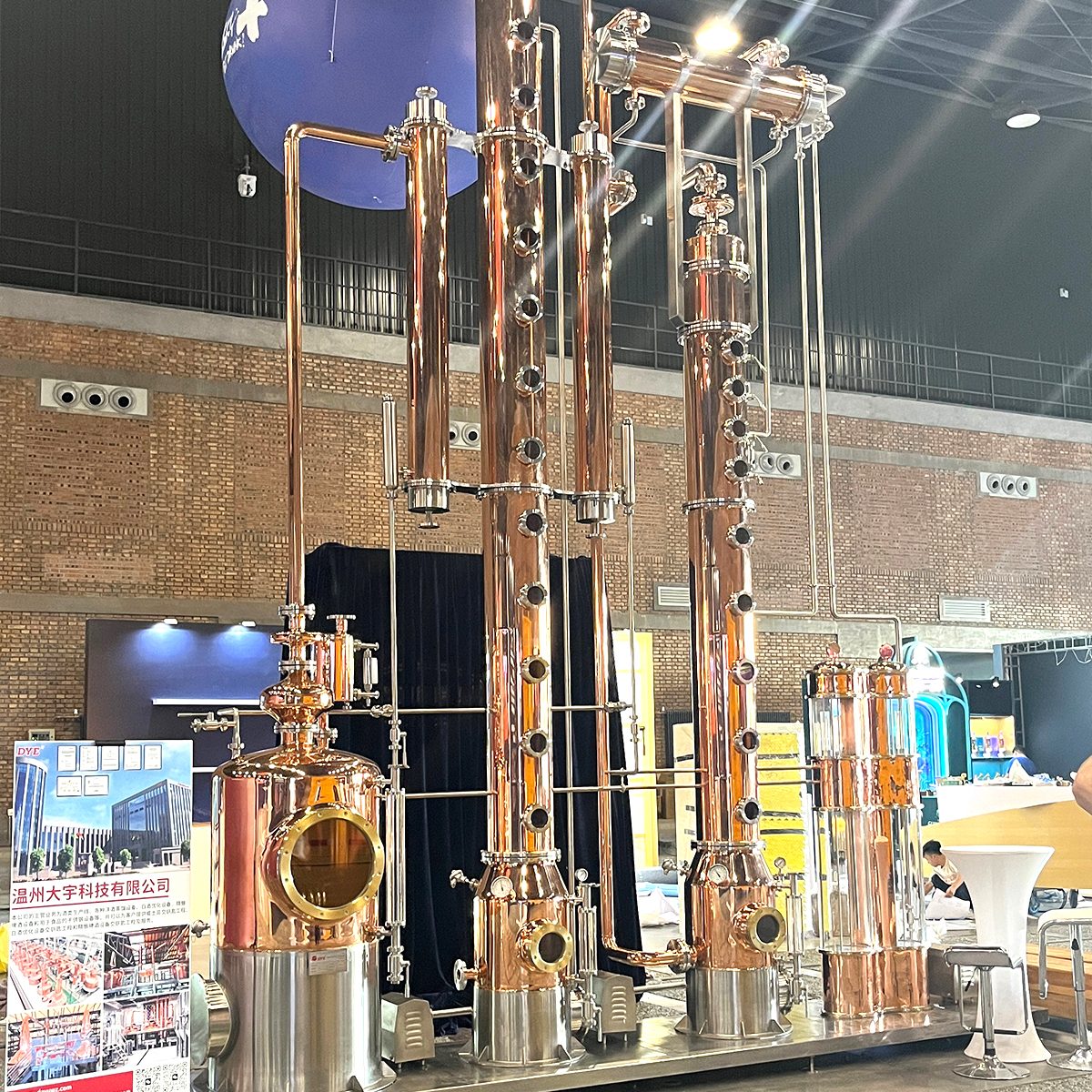
Feed enters the column at a steady rate, usually after passing through a preheater that brings it close to its bubble point. The liquid flows down across a series of trays or through structured packing, while vapor generated in the reboiler rises upward. At each contact stage, a portion of the lighter components moves into the vapor and a portion of the heavier components condenses into the liquid. This repeated exchange builds a temperature profile: cooler at the top, hotter at the bottom.
Vapor leaving the top of the column is condensed in an overhead condenser. Some of that liquid returns to the column as reflux, wetting the upper trays and sharpening the separation, while the rest is drawn off as distillate product. Near the bottom, liquid collects in the reboiler, where heat drives off vapor to supply the upward flow. A side stream or bottom draw removes the heavier fraction, and continuous operation keeps these flows balanced rather than charging and emptying the column in batches.
The separation depends on several interactive settings: reflux ratio, feed tray location, column pressure, and heat input. Raising the reflux ratio generally improves purity but costs more energy. Operators watch temperature at key trays and adjust steam or cooling water to hold the profile steady. Once the column lines out, compositions at the top and bottom remain nearly constant even as fresh feed keeps entering, which is what makes continuous distillation suitable for high-volume refining and chemical processing.
Why Batch Stills Lose Out on Efficiency
Batch stills require frequent shutdowns to empty and recharge, so the energy used to heat the pot and its contents dissipates each cycle. That repeated thermal cycling isn't just wasteful; it slows the whole operation because the still has to be brought back up to temperature before any vapor reaches the condenser.
Compare that with continuous systems, where feed enters at one end and product leaves the other without interrupting the heat input. A batch pot also suffers from poor heat integration because you can't easily preheat the next charge with the waste heat from the previous run, so a lot of BTUs go up the stack or into cooling water.
Operators tend to run batch stills conservatively, cutting the boil rate to avoid entrainment or bumping near the end of a run. That extra time per cycle doesn't show up in a simple capacity rating, but it erodes real throughput. Over a month, the cumulative idle time from filling, heating, cooling, and draining often outweighs the actual distillation time.
The Productivity Payoff Without the Quality Drop
The usual trade-off between speed and quality is often an illusion. When teams rush to ship faster, they skip reviews, ignore edge cases, and lean on shortcuts that feel productive in the moment. Then the same work comes back with defects, unclear requirements, or a design that does not hold up. The real cost is not just rework; it is the confidence lost when people stop trusting the output. A better starting point is to treat quality as a constraint, not a variable. That means defining what good enough actually looks like before acceleration begins.
Practical gains usually come from removing friction, not reducing standards. One team I worked with cut their release cycle by 40 percent after mapping every step from draft to delivery. They found that half the waiting time came from redundant check-ins and formatting debates. By automating the repetitive checks and keeping human judgment where it mattered, such as clarity of argument, visual consistency, and factual accuracy, they moved faster without lowering the bar. The key was separating decisions that benefit from speed from those that degrade under pressure.
The result is a workflow where people spend less time on busywork and more on the parts of the job that actually shape the outcome. Quality stops being a checkpoint at the end and becomes a habit in the middle. Deadlines feel less violent because the process no longer creates hidden traps. Over time, that consistency builds a reputation for reliability. And a reliable team can afford to move quickly, because speed no longer carries the risk of a messy aftermath.
Lower Operating Costs From Day One
When you switch to our system, the savings start before you even finish the onboarding call. We've automated the most time-consuming manual tasks—like data entry, invoice matching, and report generation—so your team can stop burning hours on busywork and focus on revenue-producing activities. That means lower payroll overhead and fewer overtime claims from the very first week, without any need to hire additional staff or invest in expensive training.
The platform also eliminates the hidden fees that often sneak up with other solutions. No per-seat licensing surprises, no charges for basic integrations, and no mandatory maintenance contracts. Our pricing is flat and transparent, so you can predict your monthly costs exactly. And because the system runs on your existing hardware, you won't need to purchase new servers or upgrade workstations just to get started—it's a true drop-in replacement that trims your budget immediately.
Finally, our built-in analytics continuously monitor resource usage and flag inefficiencies before they become expensive problems. You'll receive weekly recommendations tailored to your actual workflows, helping you cut waste in real time—whether it's reducing energy consumption, optimizing inventory levels, or rescheduling tasks to avoid peak-rate periods. These adjustments compound quickly, often delivering double-digit percentage savings on operating costs within the first month.
Consistent Flavor Profiles That Build Trust
When a customer orders the same dish or drink on different days, they expect it to taste the same. That simple predictability is what turns a first-time visitor into a regular. It’s not about being boring—it’s about honoring a promise. Small variations in roasting, brewing time, or ingredient sourcing can break that promise and erode confidence.
Building that reliability takes careful attention behind the scenes. Teams train against sensory benchmarks, not just written recipes. They taste batches at fixed intervals and adjust before a single cup or plate reaches the front counter. The goal isn’t to chase novelty on every visit but to make each experience feel familiar and trustworthy.
Over time, that consistency becomes part of the brand’s identity. People recommend a place not only for a great first impression but because they know exactly what they’ll get next week. That quiet assurance is harder to earn than a viral menu item, and it lasts much longer.
FAQ
A Chinese continuous still is a type of distillation column that processes a steady stream of fermented mash rather than working in discrete batches. It is usually built as a vertical column with multiple plates or packing sections, letting alcohol vapor rise while liquid descends, and it is commonly used for high-volume spirit or alcohol production.
Fermented liquid is pumped into the column near the top or middle. Inside, steam or a heating element at the base creates rising vapor. As the vapor meets the descending liquid on each plate, the more volatile alcohol components are stripped out and carried upward, while water and heavier byproducts fall back down. The alcohol-rich vapor is then condensed at the top, and the spent liquid drains continuously from the bottom.
In batch distillation you load a pot, heat it, collect the distillate, and then clean and reload. A continuous still never stops for reloading. Feed enters constantly, product is drawn off constantly, and the temperature and composition profile inside the column stays stable once the system reaches equilibrium. That changes how you manage cuts and quality control.
The main advantages are higher throughput, lower energy use per liter, and very consistent output. Because the column runs at a steady state, you avoid the swings in flavor and proof that can happen from batch to batch. It also reduces labor and downtime, since you are not repeatedly filling, emptying, and cleaning between runs.
Yes. It is less flexible than a pot still. If you want to make small experimental batches or preserve heavy, grain-forward flavors, a continuous column can strip away too much character. Startup and shutdown are more complex, and controlling the cut points for heads and tails requires careful instrumentation. It also needs a fairly constant supply of fermented mash to be efficient.
Not at all. While the design has roots in Chinese alcohol production, the same principle is used worldwide for neutral alcohol, vodka, gin base, and fuel ethanol. The term Chinese continuous still often refers to equipment manufactured or developed in China, but it can be adapted to many fermented feeds, including grains, molasses, and cassava.
Because the column reuses heat through multiple stages of vapor-liquid contact, less steam is wasted. The descending liquid is preheated by rising vapor, and the spent mash can also pass through a heat exchanger to warm incoming feed. This staged heat recovery means a continuous still can produce the same amount of alcohol with noticeably lower fuel consumption than repeated batch runs.
You need to confirm that your feedstock supply, fermentation capacity, and product demand match the still's continuous throughput. Also look at column height, plate count, and whether it includes a rectifying section for higher purity. Operator training matters because a continuous column is controlled by flow rates, temperatures, and pressure drops rather than simple pot still cuts.
Conclusion
A Chinese continuous still is not just another piece of distilling equipment; it is a fundamental rethinking of how spirits are produced. Instead of filling a pot, heating it, and waiting for a single batch to finish before starting all over again, this system feeds a steady stream of fermented mash into a column, where alcohol is separated from water, solids, and other impurities in one uninterrupted flow. That might sound simple, but the engineering behind it is precise. The mash enters near the top while steam rises from below, and as they meet on a series of perforated plates or packed sections, the alcohol vaporizes, condenses, and gets drawn off at exactly the right proof. Meanwhile, the spent grains and wastewater exit the other end, ready for disposal or reuse. This process eliminates the stop-and-go rhythm of traditional batch stills, where every run demands cleaning, reheating, and recalibrating. With a continuous still, the operator sets the feed rate, steam pressure, and draw-off points once, then lets the system run for hours or even days without interruption. The result is a distillery that behaves less like a workshop and more like a factory—predictable, scalable, and relentlessly productive.
The real payoff, though, shows up in the numbers and on the palate. Batch distilling wastes a lot of energy and time because the still must be heated from cold, emptied, and refilled repeatedly, which also creates fluctuating cuts and inconsistent flavor from one batch to the next. A continuous still sidesteps those problems by maintaining a constant temperature gradient and steady flow, which translates directly into lower fuel and labor costs per liter. And because the conditions inside the column never change, the spirit emerging at the collection point is remarkably uniform—same aroma compounds, same mouthfeel, same finish, run after run. That consistency is a huge advantage for brands trying to build consumer trust, especially in markets where buyers expect the exact same taste from every bottle. Some distillers worry that continuous distillation strips out character or depth, but modern designs allow for adjustable reflux ratios and multiple draw points, so you can still capture heavier congeners or lighter esters depending on the style you want. In other words, you gain efficiency without sacrificing the nuance that makes a spirit worth drinking. For anyone serious about scaling up production while keeping quality locked in, a Chinese continuous still is less a luxury and more a logical next step.
Contact Us
Contact Person: Ada Xu
Email: [email protected]
Tel/WhatsApp: 0577-86806088
Website: https://www.dayuwz.com/