

Chocolate Ball Mill Company Insights for Building a More Efficient Production Line
2026-11-19
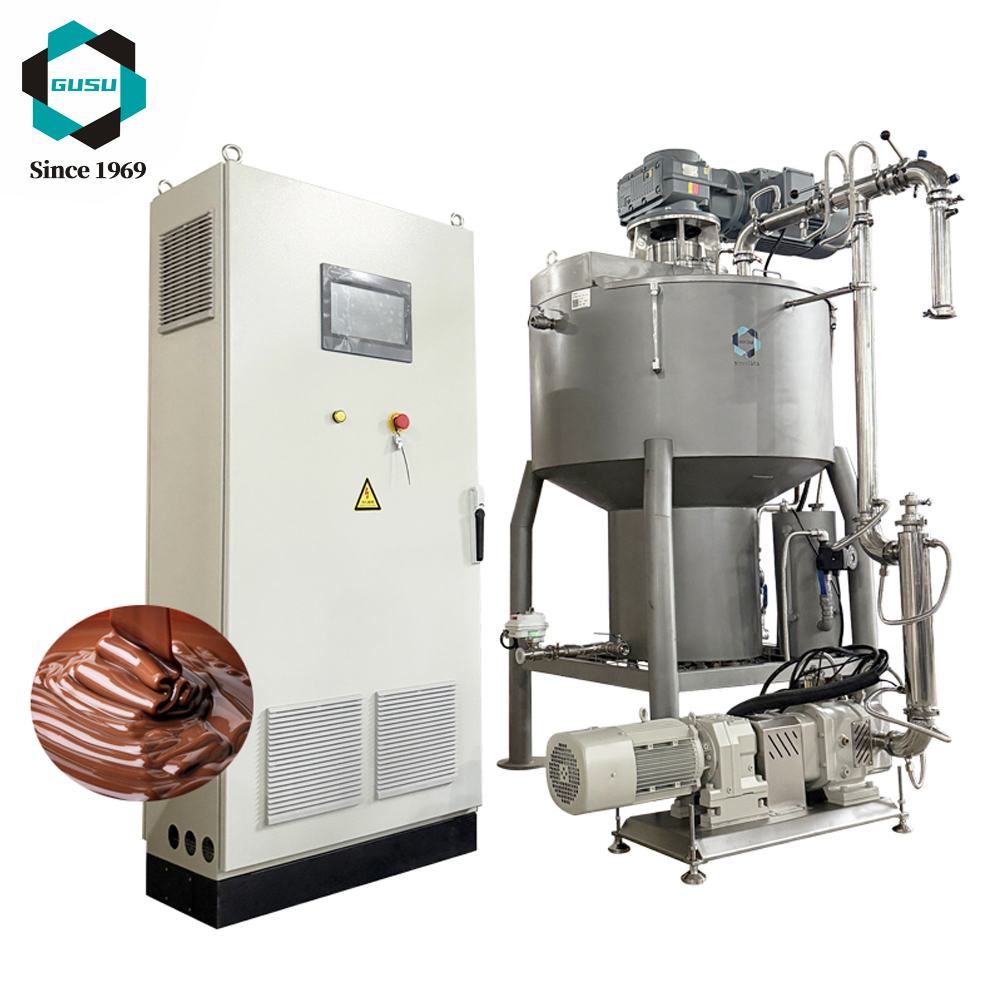
Every production manager knows the quiet bottleneck that appears when refining chocolate at scale. The ball mill is often the unsung hero or hidden culprit behind throughput limits, particle size drift, and rising energy costs. Drawing on real-world insights from chocolate ball mill company operations, this post examines the engineering and workflow decisions that separate a smooth, high-yield line from one that constantly fights downtime. With GUSU equipment as a reference point, we look beyond basic capacity numbers to what actually makes a production line more efficient day after day.
Where Your Current Throughput Actually Gets Stuck
Most teams assume their bottleneck sits at the obvious layer—more servers, a faster database, or a bigger cache. In practice, throughput rarely dies where the dashboards point. It stalls in handoffs: a queue that builds between two services because one retries too aggressively, a connection pool that shrinks under load, or a serialization step nobody thought to measure. The real constraint is often the gap between what your metrics show and what your system actually queues behind.
Another common sticking point hides in partial backpressure. One downstream consumer slows down, and instead of shedding load, the upstream keeps accepting work and buffering it in memory. Latency climbs, timeouts fire, retries multiply, and suddenly the whole pipeline is busy doing nothing useful. Throughput collapses not because any single component lacks capacity, but because the system never learned to say no early.
Fixing this requires tracing a single unit of work end to end and marking every place it waits rather than executes. You will usually find two or three small queues that never appear on a capacity chart. Remove those, and the same hardware can often move two to five times more work without adding a single core.
Grinding Media Choices That Move Particle Size Without Extra Power
Most size-reduction gains in a mill are credited to motor speed or feed rate adjustments, but the media itself often holds more leverage. A shift from a single large ball size to a blend with smaller, higher-count media can raise the number of fracture events per revolution without asking the drive for more amps. The trade-off is bite: oversized feed particles still need a few larger balls to avoid a dead zone at the inlet.
High-density media does not automatically mean higher power draw. If the charge is kept slightly below the usual fill level and the size spread is narrowed, more of the input energy goes into particle breakage instead of media-on-media scuffing. In fine grinding, smooth ceramic beads tend to run cooler and contaminate less than worn steel, but only when the top size in the feed can be captured by the smaller bead diameter.
The real adjustment is often in the grading. A mono-size charge may plateau because the contact pattern becomes repetitive, so adding a middle size or a low-profile cylinder can break the cycle without touching the gearbox. Hardness matters less than roundness, wear rate, and how the media interacts with the liner, since chips and misshapen pieces quietly shift the effective ball size away from what was originally specified.
Heat Removal at the Point Where Cocoa Butter Thins
The moment cocoa butter shifts from a fully molten state into the thinner, more fluid phase is easy to misread. It looks workable, so there is a temptation to keep it moving or hold it at that temperature. But this is precisely where heat removal needs to be deliberate. A slow, uneven drop lets longer-chain triglycerides settle into loose, unstable crystal networks that later produce dull streaks and soft snap.
In practice, removing heat at this point works best when the cocoa butter is spread into a thin film or passed across a cooled surface, rather than cooled in a deep mass. The aim is not to chill the entire batch abruptly but to pull latent heat out at a steady rate while the fluidity is still high enough for crystals to disperse. Once viscosity climbs too far, further cooling only traps unstable forms. That narrow window, after thinning and before thickening returns, is where final gloss and contraction are largely decided.
The Sifter Often Sets the Real Line Speed
On plenty of lines the mixer, oven, or packaging machine gets the attention, but the sifter quietly dictates how fast everything actually moves. If the screen area is too small or the mesh loads up too quickly, upstream equipment has to throttle back no matter what the rated capacity says. As soon as the sifter starts rejecting too much overs or the deck loses its throw, the whole line settles into a slower rhythm.
Operators usually learn this by watching the material bed on the screen and the amount of tailings coming off the end. A healthy sifter keeps a thin, even layer moving across the mesh without bouncing or piling near the inlet. When the feed rate creeps up, the screen blinds, fines carry over, and someone has to either slow the infeed or open the bypass. In that sense the sifter is not just checking quality; it is setting the pace for everyone downstream.
The practical fix is rarely to force more product through the same deck. It means matching mesh openings, ball trays, and vibration amplitude to the particle size and moisture level in the room. A sifter that runs clean at the desired throughput will let the rest of the line hit its target speed without constant stops. Otherwise the bottleneck just moves from one floor to the next, and the sifter keeps calling the tune.
Balancing Mill Speed Against Cocoa Butter Viscosity
Mill speed does more than just grind; it shapes how cocoa butter behaves under shear. A slow roll or agitator leaves the paste thick and sluggish because fat release lags behind particle breakdown. The moment speed increases, shear thinning takes over and the cocoa butter starts moving like a much lighter oil, allowing solids to stay suspended and the grinding media to bite instead of skate.
That responsiveness cuts both ways. Push the speed too high and the heat generated at the contact points begins to override the recipe. Viscosity drops sharply, which can sound helpful, but the film of cocoa butter becomes so thin that rollers lose traction and particles collide without being properly milled. You also start trading flavor for throughput, since volatile aromatics strip off faster in an overheated paste.
A practical balance usually means letting mill speed and viscosity chase each other in a narrow band: enough shear to keep the paste fluid and free-flowing, but not so much that the fat phase thins past the point of doing its job. Adjustments tend to be incremental—small changes in coolant temperature, a slight raise or drop in agitator rpm, or a staged addition of cocoa butter—until the current draw steadies and the grind sounds more like a wet slurry than a dry drag.
Vibration Patterns That Give Early Warning on Bearing Wear
Subtle shifts in the high-frequency band often appear long before a bearing becomes audibly rough. A faint rise in broadband energy, sometimes called a grass-like floor on the spectrum, shows up around the bearing's natural resonance zones. On its own this can be mistaken for normal machine noise, but when the same pattern repeats across a few measurements it usually points to early surface distress rather than a change in operating conditions.
Once localized pitting starts, the impacts settle into repeating intervals tied to ball pass frequencies. Peaks appear at BPFO or BPFI along with a few harmonics, and sidebands spaced at shaft speed begin to cluster around them. The density of those sidebands tends to matter more than the peak height alone; a crowded set of sidebands around a modest peak often indicates a defect that has already spread beyond a single pit.
Envelope analysis can expose another early pattern that a normal spectrum hides: a series of sharp, low-energy spikes in the time waveform that form a haystack-like rise in the demodulated spectrum. This pattern commonly shows up when the lubricant film is thinning and metal-to-metal contact is still intermittent. Tracking the spacing and repetition of these spikes gives an earlier warning than waiting for overall vibration levels to climb, especially in slow or variable-speed machines.
FAQ
Beyond motor size, look at the grinding chamber's internal geometry and how well the beads are retained under load. A mill that holds a stable bead charge at higher throughput prevents product inconsistency and reduces the need to slow the line down for rework.
Often in the upstream refining and downstream holding stages. If the paste isn't pre-milled to a consistent particle size before entering the ball mill, the mill is forced to do extra work, and downstream pumps can cavitate or lose prime when viscosity spikes.
Chocolate paste thickens unevenly as it heats. A mill with segmented cooling jackets lets operators adjust temperatures zone by zone, keeping viscosity stable and preventing burn-on, so the next batch reaches target fineness without repeated passes.
The easiest field check is to record amperage draw against throughput for a fixed recipe. If amperage climbs while output stays flat, the charge is likely too dense or too worn. Swapping media size rather than adding more often fixes the issue without overloading the drive.
Moisture is a hidden throughput killer. Even small amounts of residual water in sugar or cocoa solids create paste adhesion inside the chamber and alter viscosity. A dedicated pre-drying step keeps the mill working on particle size instead of fighting moisture-related surging.
Several smaller units give you more flexibility when switching between dark, milk, and white chocolate. One large mill can be more energy-efficient on a single long-running recipe, but if changeovers are frequent, parallel mills let you clean and refit one line while the others keep producing.
Watch for rising bearing temperatures, reduced water flow through cooling circuits, and a slow drift in motor current at the same settings. These usually appear before particle size goes out of spec, giving maintenance a window to replace worn discs or seals without a full line stoppage.
Conclusion
Most chocolate production bottlenecks are not where they first appear. A line can look busy while throughput stalls at the transfer into the grinding chamber or at the discharge side, where material backs up because the sifter cannot keep pace with the mill. Paying attention to these quieter constraints often yields more capacity than simply pushing the main drive harder. Choosing grinding media with the right size, density, and surface finish also shifts particle size distribution without raising energy draw, which keeps downstream conching times predictable. Media that wears too smooth or too small will quietly reduce grinding efficiency, so checking the charge condition belongs in routine line reviews.
Temperature control matters most when cocoa butter thins and the paste loses the viscosity needed for efficient grinding. Rather than chasing higher mill speed, it is usually better to balance rotor speed against the actual flow behavior of the mass and remove heat close to the grinding zone. Small changes in jacket water temperature or flow rate can stabilize the batch. At the same time, vibration trends on the mill bearings give an early warning of wear long before a failure stops the line. Combining these signals with sifter performance and media condition turns the ball mill from an isolated machine into a controllable part of the whole production line, and that is where the real efficiency gain shows up.
Contact Us
Contact Person: Zhang Wei
Email: [email protected]
Tel/WhatsApp: 8618662577837
Website: https://www.chocomachinery.com