

Custom Sand Blasting Room Factory: Tailored Solutions for Efficient Surface Preparation
2026-06-02
Surface preparation can make or break a coating's durability—but off-the-shelf sand blasting rooms often fall short when your workflow demands more. That’s where PuHua steps in, blending decades of engineering know-how with a genuine eagerness to craft exactly what your operation needs. Whether you’re dealing with oversized components, abrasive-sensitive substrates, or tight production deadlines, our factory doesn’t ask you to adapt to standard designs. Instead, we listen to your challenges and build a tailored solution around them—boosting efficiency from the very first blast. Curious how a custom approach transforms your surface prep? Let’s walk through the process.
Beyond Standard: How We Engineer Every Blast Room to Your Specifications
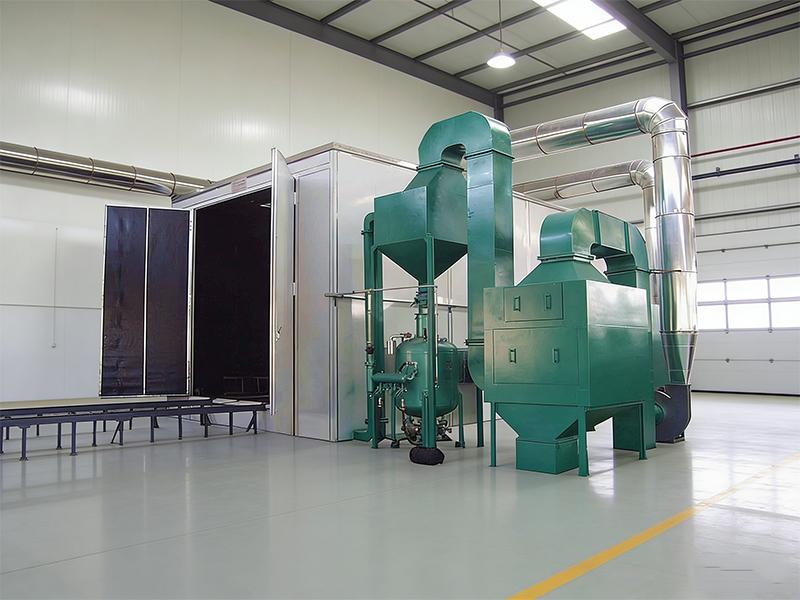
Right from the first conversation, we treat your project as a blank canvas. Our team doesn’t start with a pre-designed blueprint and hope it fits; we immerse ourselves in your specific production goals, the materials you handle, and the daily realities of your shop floor. Whether you need a compact system that squeezes into a tight footprint or a high-throughput room capable of handling massive components, every dimension, airflow pattern, and abrasive reclaim path is tuned from the ground up.
During the engineering phase, we sweat the details that cookie-cutter manufacturers overlook. Our process involves running computational models to visualize dust extraction and abrasive velocity before a single weld is made. We factor in your future growth, so the room’s structure, lighting, and media recovery system can be scaled or reconfigured later without a complete overhaul. It’s a collaborative rhythm—we share 3D walkthroughs and mock-ups early, incorporating your feedback until the design feels like a natural extension of your workflow.
What truly sets this approach apart is how we integrate the room into your broader operation. Controls and automation speak the same language as your existing machinery, and we can embed features like variable-pressure nozzles, part-tracking sensors, or custom containment for hazardous dust. Instead of adapting your process to a machine, you get a blast room that bends to the way you work—quietly delivering consistent surface finishes day after day, without the compromises that come from a generic catalog listing.
From Concept to Completion: A Step-by-Step Custom Journey
Every great project begins as a flicker of imagination—a rough sketch on a napkin, a late-night burst of inspiration. We sit down with you to listen, not just to the bullet points, but to the passion behind them. This isn't about filling out a form; it's a conversation where we tease out details you didn't even know mattered, shaping a vision that feels unmistakably yours.
Then the real magic begins: our team translates that shared vision into a living plan, tackling each phase with a mix of precision and curiosity. We prototype, test, and refine, keeping you in the loop without drowning you in jargon. You'll see your ideas evolve, and we'll pivot together when something unexpected sparks a better direction. It's a dynamic, sometimes messy, always rewarding process.
By the time we reach the final stretch, every detail has been polished to match the original spark, only richer. You don't just get a deliverable; you get something that carries the imprint of our collaboration, ready to make its mark. Handing it over feels less like an ending and more like a beginning—your concept, now fully realized, equipped to thrive in the wild.
The Heart of Efficiency: Innovative Abrasive Handling Systems
Modern manufacturing floors are rediscovering a quiet truth: the way you move abrasives shapes the rhythm of your entire operation. Instead of relying on outdated conveyors that spill grit and waste energy, facilities are turning to sealed, low-turbulence transport lines. These systems keep particle degradation to a minimum, which means less dust, fewer filter changes, and a noticeable drop in maintenance headaches. It’s a shift that feels almost invisible day to day but shows up clearly in longer run times and cleaner air.
What makes a handling setup truly innovative often isn’t a single breakthrough but a series of small, deliberate choices. Think of modular pipe networks with quick-release couplings that allow rerouting in minutes rather than hours, or wear-resistant bends shaped by computational fluid dynamics to soften particle impact. Some teams are even integrating gentle acceleration zones—short sections where material speeds up gradually, preventing the shock loads that chew through elbows and joints. Together, these details turn what used to be a loud, wear-prone chore into something reliably quiet.
Beyond hardware, the real leverage now lies in sensing and response. Embedded vibration monitors and acoustic sensors can flag a developing clog or a thinning pipe wall long before it becomes a shutdown event. Coupled with variable-speed drives that adjust flow based on real-time demand, the entire abrasive supply chain becomes less about pushing material and more about orchestrating it. Operators sleep better knowing the system self-tunes overnight, and that’s the kind of efficiency that doesn’t need a dashboard to be felt.
Built to Last: Materials and Manufacturing That Defy Wear
The secret behind extraordinary durability often lies in material selection that borders on the obsessive. Aerospace-grade titanium alloys, for instance, are chosen not just for their strength-to-weight ratio but for a natural resistance to corrosion that shrugs off years of moisture and salt. Likewise, ultra-high-molecular-weight polyethylene is quietly replacing steel in high-friction industrial components, shedding abrasion with a near frictionless calm that most metals can only envy.
Manufacturing techniques then amplify what nature cannot provide on its own. Cold-forged parts emerge with a grain structure aligned to stress paths, resisting fatigue in ways cast equivalents never could. Laser cladding deposits wear-resistant layers exactly where needed, creating components that hold their edge or surface finish long after conventional alternatives would be scrap. These aren’t just processes; they’re deliberate interventions that turn raw endurance into an engineering certainty.
Real longevity also comes from designing how things fail—if they ever do. Controlled wear surfaces sacrifice themselves gradually while protecting critical geometry underneath. Diamond-like carbon coatings and ceramic-reinforced composites push service intervals so far out that maintenance becomes an afterthought. This philosophy doesn’t just extend lifespan; it rewrites the expectation of what long-lasting truly means.
Tailored for Your Industry: Solutions from Aerospace to Automotive
Every sector brings its own set of engineering demands, material constraints, and performance expectations. Aerospace requires lightweight composites that withstand extreme temperatures and pressure differentials, while automotive manufacturing prioritizes high-strength alloys capable of enduring repetitive mechanical stress at scale. Our approach cuts across these boundaries, adapting core technologies to the specific certification and durability standards of each field.
In practice, that means the same precision machining techniques refined for turbine blades also inform the production of engine components that last longer under stop-and-go driving conditions. The coatings developed to protect airframes from corrosion at 35,000 feet are re-engineered to guard vehicle underbodies against road salt and moisture. This cross-pollination doesn’t just save development time—it hardens every solution through exposure to the toughest tests each industry can throw at it.
Whether you’re dealing with FAA regulations or IATF 16949 requirements, the thread remains the same: material integrity, process control, and an unwillingness to compromise. By operating at the intersection of these sectors, we turn compliance into a competitive edge, delivering parts and systems that perform predictably from the runway to the highway.
After the Build: Support That Keeps You Running Smoothly
The moment your project goes live isn't the finish line—it's the starting point of our real commitment. We stick around to make sure everything hums along without hiccups. Whether it's a quiet Sunday evening or a busy Monday morning, our team is on standby, ready to tackle the unexpected. No ticket queues, no canned responses. Just direct access to people who know your setup inside out.
Beyond fixing bugs, we actively monitor performance, suggest tweaks, and keep your tech stack fresh without you having to lift a finger. Think of us as a silent co-pilot, always optimizing, always watching. Because running smoothly isn't a one-time achievement—it's a rhythm we help you maintain, day after day.
FAQ
Standard rooms often force you to adapt your workflow, whereas a custom setup is built around your specific parts, dimensions, and production flow, which can shave hours off each project.
We look at the largest piece you'll handle, the material handling method, and how many operators will work inside. The goal is enough room to move freely without wasting floor space.
Absolutely. The recovery system and blast equipment can be configured for anything from fine powders to heavy grit, and switching between media is straightforward if you plan for it during the design phase.
Dust management is critical. Our systems use high-efficiency cartridge filters and properly sized ducting to keep visibility high and airborne particles below regulated limits, even during heavy blasting.
It’s collaborative but not burdensome. We’ll handle the heavy lifting, but your input on daily operations, maintenance access, and future needs ensures the room really fits your shop.
Yes, modular construction makes expansion simpler. We can also pre-plan utilities and structure for future changes, so you aren’t boxed in when business grows.
When the layout, lighting, media recovery, and part handling all work together seamlessly, you spend less time on setup and cleanup, and operators can maintain a steady rhythm. That translates directly to more throughput.
Conclusion
Every surface preparation challenge comes with its own set of demands, and off-the-shelf blast rooms rarely rise to the occasion. That’s why this factory rejects the one-size-fits-all mindset, instead engineering each enclosure from scratch around the client’s workflow, material types, and production targets. The process begins long before a single bolt is tightened—our team maps out the entire operation, factoring in part dimensions, desired finish quality, and environmental constraints. From there, structural layouts, ventilation patterns, and media recovery pathways are designed to fit like a glove. This tailored approach means a facility coating turbine blades for aerospace operates under vastly different parameters than one stripping heavy automotive castings, yet both receive a system that feels purpose-built, not adapted.
At the core of these rooms lies an abrasive handling system that treats every grain of media as a reusable asset, sifting, cleaning, and redirecting it with minimal waste. The chosen materials for walls, floors, and recovery components are selected not just for toughness but for how they react to repeated high-velocity impact—abrasion-resistant steels and composites are layered precisely where wear concentrates, extending service life far beyond industry norms. And when a room is already in service, support doesn’t end at commissioning; remote diagnostics, readily available wear parts, and retrofit guidance keep operations humming years down the line. Whether it’s a compact cell for delicate medical implants or a cavernous bay for railcar restoration, the final product reflects a deep understanding that true efficiency isn’t about moving air and grit faster, but about fitting the technology so seamlessly into a production line that surface preparation becomes an afterthought.
Contact Us
Contact Person: Bruce
Email: [email protected]
Tel/WhatsApp: +86 15166629468
Website: https://www.povalchina.com/