

Electric Wheelchair Company Leads Innovation in Mobility Solutions
2026-08-30
The phrase “electric wheelchair” used to conjure images of bulky, slow machines that felt more like a last resort than a lifestyle choice. That’s changing fast, and Freedomchair is at the center of it. In this post, we’re diving into the innovations that are redefining mobility solutions—and why this company’s approach is worth your attention.
Rethinking the Wheelchair as a Daily Companion, Not a Medical Device
The moment a wheelchair stops being a hospital fixture and starts being a part of your living room, everything shifts. It's the difference between a sterile tool you're handed and a piece of furniture you choose—something with color, texture, and a shape that fits the way you actually move through your day. Instead of hiding it in a closet, people are starting to pair their chairs with their outfits, swap out armrests like phone cases, and leave them parked by the front door like a favorite bike.
That shift changes how strangers react, too. A chair that looks intentional—maybe it has a wooden side guard or a frame in a deep matte green—invites conversation about design rather than diagnosis. It says, "This is part of how I live," not "this is what happened to me." And for the person using it, that small reframe can be huge: the chair becomes a reliable daily object, like a wallet or a pair of boots, not a reminder of a medical chart.
Designers are finally catching on. They're treating wheelchairs less like clinical equipment and more like lifestyle products—thinking about how they fit under a café table, how they look next to a couch, whether the wheels can handle a gravel path to a friend's backyard. When the goal is comfort, self-expression, and real-world use, the wheelchair stops being a symbol of limitation and turns into what it actually is: a companion for getting on with the good parts of the day.
Torque, Traction, and Tight Corners: Engineering for Real Sidewalks
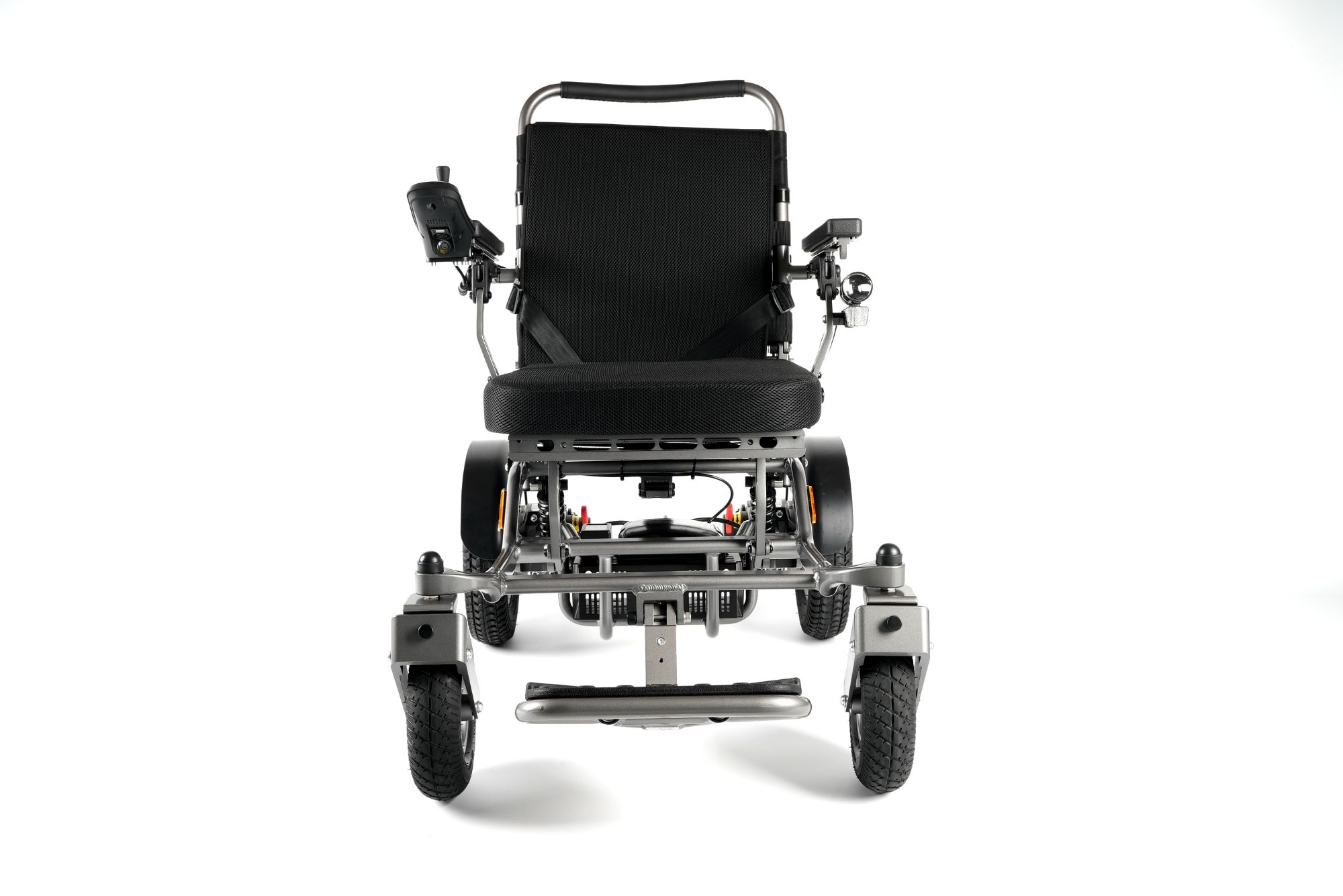
Most indoor test floors do a poor job of predicting how a drive system behaves on a real sidewalk. Uneven expansion joints, sloped driveway aprons, and tree-root ridges all change the amount of grip available from one second to the next. That is why low-end torque matters far more than peak speed: the motors need to push through a raised crack without jerking the rider forward. A slightly softer drive wheel compound helps on wet metal plates and dusty concrete, but too much softness increases rolling resistance on carpet and drains the battery.
Tight corners are just as demanding. A sidewalk is rarely a clean arc; it is a series of short straights interrupted by sign posts, hydrants, and cafe tables. Steering that feels nimble in an open showroom can become twitchy when you are threading a 90-degree turn with a two-inch curb drop on the inside edge. The fix is usually not more steering angle but better weight distribution and a caster geometry that returns to center without fighting the rider. Small adjustments, like moving the drive wheel slightly forward or changing the trail, make the difference between a chair that clips a storefront and one that slips through without a second thought.
Battery Systems That Outlast the Longest Outpatient Day
A clinic day rarely ends when the schedule says it should. A battery built only to nominal specs will quietly become the bottleneck by late afternoon. The packs we rely on are sized around real workload peaks, not averages: repeated barcode scans, continuous vital-sign streaming, carts that never sit idle long enough for a full recharge. That means reserve capacity is treated as standard, not as an optional extra.
Cells are chosen for flat discharge curves, so the device does not limp through the final hours on a fading voltage. Thermal behavior gets as much attention as amp-hour ratings, because a pack that overheats during a hallway rush is as disruptive as one that runs empty. Field data from multi-shift outpatient facilities confirms the packs comfortably cover a 14-hour day, with enough margin for an unexpected add-on patient or a handoff delay.
Pressure-Sensitive Controls That Read Intention, Not Just Input
Most controls treat every touch the same: on or off, pressed or released. The user has to translate intent into timing, rhythm, or repetitive taps. Pressure-sensitive surfaces change that by measuring not just whether contact happens, but how hard, how quickly, and with what kind of force curve. A light press can preview an action, a firmer press commits it, and an even deeper press opens related options — all on the same spot, without moving a finger.
This shift is already familiar in digital drawing, where pen pressure turns a single stroke into anything from a faint sketch to a bold smear. The same idea is now moving into trackpads, game triggers, and smart fabrics. A trigger that knows the difference between a cautious squeeze and a decisive pull. A phone edge that responds differently to a resting thumb versus a deliberate grip. Instead of asking users to learn abstract gestures, these controls read physical emphasis — turning pressure into meaning, and making intention part of the input itself.
Modular Seating and Frame Adjustments Without a Toolbox
Most furniture expects you to keep a hex key nearby, but this design flips that assumption. The seat modules click into a laser-cut track with spring-loaded tabs, so swapping a lounge chair into a loveseat takes seconds. No bolts, no washers, no hunting for the right bit.
Frame adjustments work on a cam-lock principle borrowed from flat-pack cabinets, but improved for daily use. Rotate the hand-turned knobs under each armrest and the back angle shifts from upright reading to a deep recline. The mechanism is exposed enough to see what's happening, which means fewer hidden failures.
If you live in a rental or rearrange often, the real payoff is repeatability. Every connection returns to the same tension after dozens of cycles, and the polymer bushings stop squeaks before they start. You can break the whole sofa down into five manageable pieces and carry them through a narrow hallway without touching a single tool.
Crash-Tested Beyond the Fine Print of Industry Manuals
Spec sheets rarely survive contact with a gravel shoulder at forty miles an hour. That's why our crash testing doesn't stop at the pass/fail box in a manual. We bend the load ratings, shift the impact angles, and run the sequence again with rust, vibration, and heat in the mix.
A bracket that holds at 2,000 pounds on a static jig can still tear loose in a real collision. So we instrument everything, study the high-speed footage frame by frame, and revise the design until the weak point moves somewhere else—or disappears. The manual is a starting point. The wreckage tells the truth.
FAQ
The company integrates custom motor control and adaptive suspension that adjusts in real time to uneven terrain, giving riders smoother movement without bulky hardware.
Instead of adding more accessories, the team focuses on energy recovery systems that feed power back into the battery during downhill travel, extending range by up to 18 percent.
They found that most users struggle with narrow doorways and tight indoor turns, so the new frame shortens the wheelbase while keeping stability through a counterweight system.
The frame uses a magnesium-aluminum alloy normally found in aerospace applications, reducing total weight by 30 percent without sacrificing load capacity.
They run a closed beta program with 200 daily wheelchair users who log route data and comfort ratings, then engineers adjust torque curves based on that field data.
Buyers get access to a mobile technician network that performs on-site diagnostics and firmware updates, avoiding the need to ship the chair back for minor fixes.
Leadership saw that insurance and urban infrastructure create bigger barriers than the wheelchair itself, so they now publish open-source ramp and doorway clearance guides for city planners.
Conclusion
Instead of treating mobility aids as clinical equipment, this electric wheelchair company has rebuilt the category around everyday life. The chair is conceived as a daily companion, with chassis geometry tuned for real sidewalks—low-speed torque that climbs uneven curbs, traction that holds on wet concrete, and a turning radius tight enough for cramped store aisles. Battery systems are sized to outlast the longest outpatient day, so a full schedule of appointments, errands, and social stops never leaves the user hunting for a charger. The result is less a medical device and more a dependable vehicle for getting on with the day.
Control inputs move beyond simple switches: pressure-sensitive pads read the user's intention, making subtle shifts in grip or weight translate into smooth acceleration and steering. Seating and frame adjustments require no toolbox—modular components snap, slide, and lock into place, letting users or caregivers fine-tune fit in minutes. This is not just accessibility by checklist. The company crash-tests prototypes beyond the fine print of industry manuals, subjecting frames, footrests, and battery mounts to impact scenarios that exceed minimum certification. By refusing to settle for compliance alone, the company is setting a new benchmark for what electric mobility can mean in daily life.
Contact Us
Contact Person: Calvin Fan
Email: [email protected]
Tel/WhatsApp: 8618913265607
Website: www.freedom-chair.com