
Flexible Stone Veneer Factory Secrets: Crafting Lightweight, Real Stone Surfaces
2026-08-05
What if you could have the timeless beauty of natural stone without the weight and hassle? At Magic Stone, we transform raw stone into feather-light, flexible veneers through a proprietary process that remains an industry secret—until now. Join us behind the scenes to uncover how we craft real stone surfaces that bend expectations and open up a world of design possibilities.
The Thin Stone Transformation You Never Thought Possible
Imagine a material so delicate it seems to float, yet strong enough to reshape entire rooms. Thin stone veneer is doing just that, turning ordinary walls into breathtaking focal points. It's a surface so light and flexible, you can apply it almost anywhere—from kitchen backsplashes to fireplace surrounds—without the weight and hassle of traditional stone. The transformation is so seamless, guests will wonder how you managed to transport slabs of natural rock indoors.
Beyond its stunning appearance, this material bends light and shadow in ways thick stone never could. Its featherweight profile allows for creative installations: curved walls, ceiling accents, even furniture inlays. Each slice is a genuine piece of nature, with unique veins and textures, yet it installs with the ease of ceramic tile. The result is a space that feels both rugged and refined, ancient and avant-garde.
You might think such luxury requires a massive renovation, but thin stone transforms rooms in a weekend. It cleaves directly to existing surfaces, bypassing the need for structural reinforcement. Suddenly, that bland hallway or tired bathroom becomes a gallery of natural art. It’s not just a new look—it’s a new possibility for your home, one you never thought achievable.
Why This Lightweight Alternative Is Replacing Traditional Masonry
The shift toward lightweight building materials isn't just a trend—it's a response to real-world demands that traditional masonry can no longer meet. Solid bricks and concrete blocks bring undeniable strength, but they also come with excessive weight, slow installation times, and a punishing toll on labor and logistics. In contrast, newer alternatives offer a fraction of the mass without sacrificing durability, making them especially attractive for projects where speed and cost containment are paramount. The math is simple: when you can move, cut, and install panels with minimal crew and equipment, the entire construction schedule accelerates in ways masonry simply can't match.
Beyond logistics, the performance gap in thermal efficiency and moisture resistance has widened significantly. Traditional masonry, with its thermal mass, often works against modern energy codes unless heavily insulated, while many lightweight systems integrate insulation directly into their profiles, slashing heat loss without adding bulk. They also sidestep the common headaches of mortar joint deterioration and efflorescence, requiring far less upkeep over the building's lifespan. This combination of lower operational costs and reduced maintenance is quietly tipping the scales for architects and developers who are tired of fighting the same old battles with brick and block.
Perhaps the most overlooked driver, though, is design flexibility. Masonry locks you into rectilinear forms and repetitive load calculations, whereas lightweight alternatives allow for cantilevers, curves, and rapid reconfiguration without massive structural reinforcement. They're also friendlier to offsite prefabrication, meaning panels arrive ready to install with openings and finishes already in place—a concept that traditional masons, reliant on wet trades and curing time, struggle to replicate. It's not that masonry will disappear, but for a growing share of projects, the smarter choice comes in a lighter package.
Inside the Process: From Natural Rock to Flexible Veneer
The transformation begins deep within quarries where massive blocks of natural stone—slate, mica, or sandstone—are carefully extracted. Each layer tells a geological story spanning millions of years, and the selection process is meticulous. Not every slab makes the cut; only those with consistent thickness, rich coloration, and minimal flaws are chosen. These raw pieces are then transported to specialized facilities, where they await a metamorphosis that will turn rigid rock into something surprisingly supple.
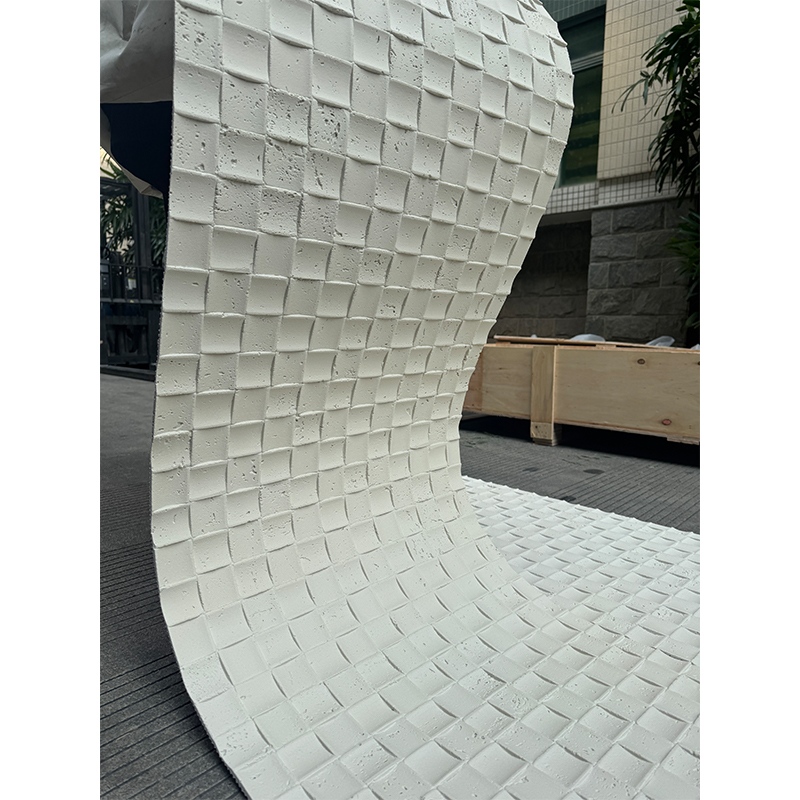
At the heart of the process lies a delicate exfoliation technique. Using advanced splitting equipment, artisans separate razor-thin layers from the stone, sometimes achieving a thickness of just a fraction of a millimeter. These fragile slices are immediately stabilized on a backing material—often a blend of fiberglass and polyester resin—which grants them flexibility without sacrificing the authentic texture and veining of the original rock. The marriage of ancient material and modern composite ensures the veneer can bend, curve, and wrap around surfaces that would defeat conventional stone.
After curing, each sheet is meticulously inspected, trimmed, and finished. Some varieties receive a light sanding to accentuate natural patterns, while others are treated with UV-resistant coatings to lock in their hue for decades. The result is a product that defies expectations: a genuine stone surface that weighs a fraction of its slab counterparts, can be cut with standard woodworking tools, and adapts to architectural curves. It’s a quiet revolution in material design—one that preserves the raw beauty of the Earth in a form that’s as versatile as it is elegant.
Real Stone, Zero Compromise: How Strength and Flexibility Coexist
It’s rare to find a material that doesn’t ask you to choose between toughness and subtle adaptivity. Yet here lies a surface born from ancient geological pressure, naturally structured to bear massive loads while bending just enough to avoid shattering under stress. The crystalline matrix within every slab provides a hidden lattice of micro-flexion points—something engineering often tries to mimic but rarely captures without additives.
What makes it work is the arrangement of minerals formed over millennia. Heat and pressure fused the components without destroying their individual integrity, creating a composite that behaves like a strong yet forgiving net. Push on one area, and the force dissipates across invisible boundaries, sparing the surface from brittle failure. That’s why it can hold up a marble countertop’s overhang while absorbing the vibration of a busy kitchen, or clad a skyscraper that withstands both gale-force winds and the slow thermal dance of day and night.
You see this coexistence in the most unexpected places—a cantilevered bench that seems to float, a floor that resists cracking despite decades of shifting foundations, a facade that reflects light without ever yielding to weather. No synthetic core, no mesh backing, just the real thing performing a quiet miracle of duality that keeps architects and users from having to choose.
Hidden Innovations Behind Those Natural-Looking Stone Walls
The seamless blend of stone walls into natural landscapes often hides remarkable engineering. Beyond the visible aesthetics, builders employ geogrid reinforcement and precisely graded backfill to manage drainage and prevent bulging. Modern techniques like soil nailing and mechanically stabilized earth ensure these walls withstand pressure without massive concrete foundations, preserving the organic look while delivering lasting stability.
The Art of Matching Nature’s Palette: Custom Veneer Craftsmanship
In the realm of fine woodworking, there is a quiet conversation that happens between the artisan and the tree. Each veneer leaf holds a distinct story—a swirl here, a ripple there—shaped by decades of sun, soil, and rain. Custom veneer craftsmanship is not about forcing uniformity; it's about listening to what the wood already wants to say. The real skill lies in selecting and placing each piece so that the finished surface feels cohesive, yet alive with the unpredictability of nature.
Matching nature's palette demands a trained eye that sees beyond color. It's a tactile and visual meditation—feeling the grain direction, catching the way light skims across a curl, noticing how two panels from the same tree can whisper differently when laid side by side. This isn't mass production. It's a slow, deliberate practice where the maker might shift a single sheet a dozen times before it settles into its rightful place. The goal is a seamless flow that honors the raw material's inherent rhythms.
What emerges is more than a surface; it's a composition. Walls, cabinetry, or furniture become landscapes that shift with the daylight, never static, always suggesting something new. In the hands of a skilled craftsperson, veneer becomes a medium for storytelling—preserving the tree's legacy while creating an atmosphere that can't be replicated by synthetic alternatives. It's this blend of humility and precision that makes custom veneer work feel less like construction and more like collaboration with the natural world.
FAQ
The secret lies in peeling ultra-thin layers from real stone using advanced polymer backing. Instead of cutting thick slabs, we extract a millimeter-thin stone layer and bond it to a flexible composite, reducing weight by up to 80% while keeping the genuine texture.
We source stone from multiple quarries and never use artificial patterning. Each batch comes from a different natural cleavage, so variations in veining and hue are inherent. Our process preserves these details, making every sheet one-of-a-kind.
Absolutely. The flexibility comes from the reinforced backing that allows bending up to a 90-degree curve. Installers can wrap it around pillars or arches seamlessly, and since it's real stone, it won't discolor or warp like synthetic alternatives.
We've engineered a closed-loop system where unused stone particles are collected and repurposed into architectural aggregates. The resin we use is solvent-free, and water recycling cuts consumption by half, so almost nothing goes to landfill.
Despite being thin, it's remarkably tough. The polymer backing absorbs impacts that would chip solid stone, and the surface is sealed to resist stains and scratches. Many commercial lobbies use it for floors and feature walls with minimal wear after years.
It's suitable for most interior and exterior surfaces, but we avoid prolonged submersion areas like pools. Direct UV exposure over decades might slightly fade some colors, so we recommend a UV-resistant topcoat for facades in very sunny climates.
Just mild soap and water occasionally. The factory sealant prevents deep staining, so red wine or coffee can be wiped off easily. No need for special cleaners or resealing like common stone tiles.
Our quality team hand-inspects every sheet under calibrated lighting. Color variation is expected, but thickness and flexibility are laser-checked. We maintain a tight tolerance by controlling the peeling process temperature and speed, ensuring each sheet meets structural standards.
Conclusion
Walking through a flexible stone veneer factory feels like stepping into a geological alchemy lab where massive slabs of natural rock are transformed into something almost magical: a thin, bendable membrane that still carries the weight, texture, and timeless beauty of real stone. The process begins by carefully selecting layered sedimentary rocks like slate or mica, which naturally cleave into thin sheets. Skilled technicians then bond these delicate stone layers to a flexible backing—often a composite of fiberglass and polymer—using advanced adhesives that won’t compromise the stone’s breathability. The real secret lies in the precision peeling technique, where a fraction of a millimeter is shaved from the rock face, preserving every ridge and fissure. This creates a veneer so lightweight that a single person can carry enough to cover an entire accent wall, yet so durable it can be bent around curved surfaces without cracking—a true marriage of strength and pliability that once seemed impossible.
What makes this innovation even more remarkable is how it sidesteps the drawbacks of traditional masonry. You no longer need a structural engineer to reinforce floors or a crew to lug heavy blocks; installers simply apply adhesive and press the flexible sheets into place, cutting installation time dramatically. Beyond the engineering, there’s an artistry that takes center stage: colorists meticulously mix natural mineral pigments to replicate the nuances of real stone veins, mossy greens, and iron rust streaks. These custom-crafted batches are then hand-applied to ensure that no two panels are identical, yet they blend seamlessly across a wall. The result is a surface that fools even the most discerning eye—authentic stone, with absolutely zero aesthetic compromise, but with a hidden genius that makes it as practical as it is beautiful.
Contact Us
Contact Person: Vito
Email: [email protected]
Tel/WhatsApp: 86 13088879266
Website: https://www.magicstonemcm.com