

Top Servo Motor Magnets: Choosing the Best Option for Your Application
2026-10-28
Choosing servo motor magnets isn't just about picking the strongest grade. It's about matching coercivity, temperature stability, and geometry to how your motor actually runs. Most buyers get this wrong. In this guide, we break down the top options, and why DAWA magnets keep showing up in high-performance servos.
Magnet Materials That Actually Matter for Servo Performance
When it comes to servo performance, the magnet material choice dictates more than just raw torque density. NdFeB magnets dominate high-end servos because they pack the highest energy product available, but their behavior under heat is where many designs quietly fail. Above 80–120°C, standard neodymium grades start losing field strength reversibly, and if pushed past their intrinsic coercivity limit, the loss becomes permanent. That's why heavy-rare-earth additions like dysprosium or terbium aren't just a cost markup—they're often the only thing preventing a servo from turning into a paperweight after a thermal overload.
SmCo magnets look weaker on paper, with lower remanence than high-grade NdFeB, but they earn their place in servos that run hot or face aggressive demagnetizing fields. Their temperature coefficient is roughly half that of neodymium, and the knee in their B-H curve sits far enough out that you rarely need to overdesign the magnetic circuit just to survive a stall condition. The trade-off is mechanical fragility and price, which makes SmCo a niche choice rather than a default alternative.
Ferrite and bonded magnets sometimes sneak into low-cost servo motors, but calling them "performance" materials is misleading. They work fine in low-speed, low-accuracy applications where torque ripple doesn't matter much. For anything that needs fast response and high holding torque, the practical decision almost always narrows to a specific NdFeB grade chosen by its maximum operating temperature and coercivity, not by its marketing datasheet number.
Temperature Stability: The Silent Killer of Motor Precision
Temperature shifts don’t announce themselves with a fault code. They creep into the rotor and stator clearances, changing how much the shaft floats before the first move command even lands. A motor tuned at 22°C may hold ±2 arcminutes, but after thirty minutes of load the housing grows unevenly and that same command lands five or six arcminutes off. The error is rarely dramatic—just a slow, repeatable bias that looks like backlash or a worn coupling.
What makes thermal drift so frustrating is that it moves with the duty cycle. Short moves heat the windings faster than the frame, so the error profile changes within a single batch. Some engineers chase it with encoder feedback, only to find the encoder bracket expands at a different rate than the shaft. The fix usually isn’t a better motor; it’s mapping the warm-up curve and either waiting for equilibrium or compensating the trajectory before the drift settles in.
Balancing Cost and Torque: Where to Draw the Line
Engineers love chasing peak torque figures, but the moment a spec sheet demands 400 Nm, procurement starts sweating over bearing sizes and gear tooth geometry. The real question isn't whether you can hit the number—it's whether the extra 10% costs twice as much. A cast iron housing might handle the stress, but a well-ribbed aluminum design with tuned resonance could shave 30% off material cost while keeping deflection within acceptable limits.
Sometimes the cheapest torque is the torque you don't need. Oversizing a motor for a worst-case load that occurs 2% of the duty cycle is a classic money pit. A smaller motor paired with a modest gear reduction often lands in a sweet spot where the added component cost is less than the premium for the bigger direct-drive unit. The trick is modeling the actual load profile instead of designing for a hypothetical stall condition that never happens in practice.
There's also a hidden cost in thermal management. Pushing a cheaper, lower-torque motor harder means more current, more heat, and a shorter lifespan—so the upfront savings evaporate in warranty claims. The line worth drawing is where a 15% torque boost stops requiring exotic magnets or liquid cooling. Past that point, you're no longer paying for performance; you're paying for bragging rights.
Geometry and Magnetization: Getting the Field Right
Magnetization is never just a material property—it is a conversation between the shape of an object and the field it sits in. A sphere magnetizes uniformly under a uniform applied field, so its internal field stays clean and predictable. But change the geometry even slightly, and the story splits. A thin plate magnetized perpendicular to its surface develops strong demagnetizing effects near the edges, while a long rod aligned with the field almost ignores those corrections. The geometry quietly decides how much of the external field actually reaches the material’s interior.
In practice, this means two magnets with identical composition can behave like completely different devices. The same alloy in a flat disc and in a horseshoe shape will produce very different field maps, simply because the magnetic poles redistribute themselves to minimize energy in the given shape. Sharp corners and narrow gaps force abrupt field gradients; smooth, closed loops tend to produce gentler, more uniform regions. Engineers who skip this step often find their simulations don’t match the bench measurement—not because the physics broke, but because the geometry was treated as an afterthought.
Getting the field right starts with sketching the flux paths before any finite element analysis. Ask where the poles will form, how the field will return, and which surfaces will fight against the magnetization. Then adjust the shape—round the corner, widen the gap, or extend a pole piece—until the field lines behave. Only after the geometry has earned its place do material selection and coil design make sense. A well-chosen shape can turn a mediocre magnet into a precise actuator, while a poorly chosen one will waste energy in leakage and unwanted saturation.
Environmental Factors You Can't Ignore
Most people focus on the obvious when evaluating a location—weather, cost of living, or job market. But the environmental factors that quietly shape your daily experience often go unnoticed until you've already settled in. Think about the angle of sunlight in your living room, the way wind funnels between buildings on your street, or the background noise that becomes the soundtrack of your life. These details don't show up in a standard report, yet they affect your sleep, your mood, and even how often you open your windows.
One of the most underrated elements is air movement and ventilation patterns in your specific microclimate. A house on the east side of a hill might enjoy cool afternoon breezes, while a flat three blocks away feels stagnant. Similarly, proximity to green spaces isn't just about aesthetics—trees buffer both heat and sound, creating pockets of calm. If you're renting or buying, spend time in the area at different hours: during morning rush, mid-afternoon, and after dark. Pay attention to what your body notices before your brain does.
Another factor that gets buried in data is the quality of natural light throughout the year, not just in summer. A south-facing window might seem ideal until you realize the winter sun sits too low, leaving your workspace in shadow for months. Likewise, artificial light pollution from nearby commercial strips can turn a quiet residential street into a place where you never truly see stars. These aren't flaws you can easily fix with curtains or a lamp. They're part of the environment's fingerprint, and ignoring them means fighting against your surroundings every single day.
Real-World Trade-offs: Finding Your Fit
Most decisions look cleaner on a whiteboard than they do in production. A framework that benchmarks beautifully might demand three extra services just to handle session state, while a simpler stack leaves you writing boilerplate every afternoon. The real test isn't which option wins on paper; it's which one you can live with at 4 p.m. on a Friday when something breaks and the person who chose it is already gone.
That's why fit matters more than raw capability. A small team without dedicated ops support might gravitate toward boring, well-documented tools that don't require a specialist to untangle. A larger team with established patterns can absorb a steeper learning curve if it removes a recurring bottleneck. Neither choice is objectively better, but each makes sense in a specific context.
The useful move is to list what you're willing to trade. If you refuse to sacrifice deployment speed, accept that you may inherit more configuration debt. If you want long-term flexibility, expect early development to feel slower. Once those terms are explicit, the decision stops being a hunt for a perfect solution and becomes a matter of choosing the trade-offs you can actually manage.
FAQ
Most servo motors rely on neodymium iron boron (NdFeB) because it delivers the highest energy density, meaning you get more torque from a smaller rotor. Samarium cobalt (SmCo) is the go-to when temperatures climb or corrosion resistance matters, though it costs more and can't match NdFeB's raw strength. Ferrite magnets occasionally appear in budget or low-demand designs, but their lower flux output usually rules them out for precision servos.
Temperature is often the deciding factor. Standard NdFeB grades start losing performance above 80–100°C, and once you pass the Curie point, demagnetization becomes permanent. High-temperature NdFeB grades with added dysprosium or terbium can push that limit to 150°C or higher, but for sustained exposure above 180°C or aggressive thermal cycling, samarium cobalt is usually safer despite the higher price.
Coercivity measures how well a magnet resists demagnetization from external fields or heat. In a servo motor, the magnets face strong opposing fields during rapid acceleration and braking, so a higher-coercivity grade—like an H or SH NdFeB—prevents the rotor from losing strength over time. Choosing a low-coercivity magnet to save a few dollars often leads to torque fade and premature failure.
Bonded magnets are easier to mold into complex shapes and run quieter, but their magnetic performance is much lower than sintered magnets. For high-precision servo applications that demand fast response and high torque density, sintered NdFeB or SmCo is the standard. Bonded magnets might work in small, cost-sensitive motors where top-tier performance isn't required.
Start with the torque and speed requirements, then work backward. NdFeB gives you the smallest, lightest rotor for a given torque, which is critical in robotics and aerospace. If the motor runs hot or in a harsh environment, the added expense of SmCo can prevent costly failures. Cheap ferrite magnets rarely make sense for servo duty; the weight and size penalty usually outweigh the savings.
Radial magnetization aligns the magnetic field outward from the rotor's circumference, which suits most cylindrical servo motors. Axial magnetization, where the field runs along the shaft axis, is used in flat or disc-type motors. The choice depends on the motor topology—radial is common in conventional servos, while axial flux designs are gaining ground in compact, high-torque applications like electric vehicle auxiliary systems.
NdFeB magnets are prone to corrosion, especially in humid or salty environments. A proper coating—usually nickel-copper-nickel, epoxy, or zinc—protects the magnet and prevents rust from weakening the rotor. For servo motors in marine or washdown settings, epoxy or multi-layer coatings are worth the extra cost because a corroded magnet can shed particles and damage the motor's air gap.
Beyond grade and size, think about tolerances, coating thickness, and batch consistency. A magnet supplier that can hold tight dimensional tolerances and provide full magnetic test reports saves you from field failures. Also ask about lead times and whether they can support quick prototyping—servo motor designs often need several iterations before the rotor and stator match perfectly.
Conclusion
Servo motors demand more than just high pull strength from their magnets. The material choice sets the baseline, but temperature behavior often decides whether a motor holds its precision over a long run. Neodymium magnets deliver impressive torque density, yet their coercivity can drop noticeably as the windings heat up; Samarium Cobalt holds up better at elevated temperatures but costs more and gives up some room-temperature flux. Ferrite is cheap and corrosion-friendly, but its lower energy product forces a larger rotor diameter, which may not fit compact designs. The practical trick is to weigh torque against cost not by catalog numbers alone, but by looking at the magnet's demagnetization curve at the actual operating temperature, because a modest drop in flux can turn into a big positioning error once temperature stability is included.
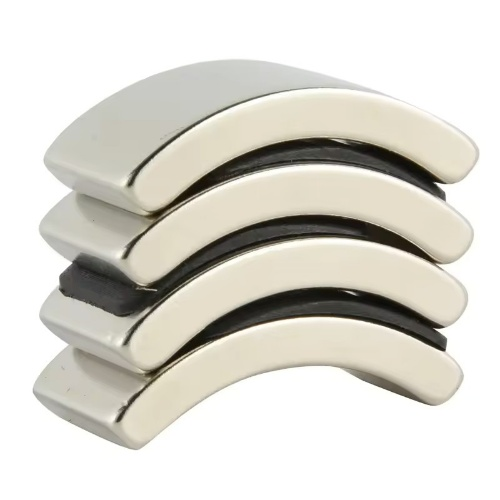
Geometry and magnetization direction are just as decisive. A simple ring magnet with radial orientation is easy to source, but it can create ripple and cogging that feed into vibration. Segmenting the rotor, skewing the magnet poles, or moving to a Halbach-style array often gives a smoother field and better control without changing the material. Environmental factors further narrow the field: humidity and salt spray will eat into unprotected iron or neodymium, while shock and vibration can chip brittle magnets unless the coating and mounting method are chosen with the actual duty cycle in mind. In the end, the best servo magnet is rarely the one with the highest energy product on a datasheet. It is the one that holds its flux within your thermal window, fits the available space, survives the operating environment, and does not force you to overpay for performance you will never use.
Contact Us
Contact Person: Kelvin Lo
Email: [email protected]
Tel/WhatsApp: 0769-88561131
Website: https://dawamagnetic.com/